
When Performance Systems Create the Problem They Claim to Solve
A governance analysis of forced distribution performance systems and the operational, cultural, and capital costs they quietly manufacture.

Executive Summary
Forced percentile stack ranking is among the most quietly destructive control systems still operating inside large enterprises. It is presented as a disciplined, objective method for differentiating talent and protecting performance standards. In practice, it functions less as a measurement instrument and more as an internal pressure mechanism. It manufactures the dysfunction it claims to police, and it does so in ways that rarely appear cleanly on a financial statement until the underlying delivery system has already begun to corrode.
The mechanism is structural rather than behavioral. When managers are required to distribute ratings across a fixed curve, absolute performance stops being the primary input. The model still demands a bottom band even when an entire team has delivered. The decision quietly shifts from “Did the work succeed?” to “Who must be placed lower this cycle?” That single constraint reshapes how performance is discussed, how decisions are made, how managers behave toward their teams, and how individual contributors behave toward one another. None of these effects are accidents of execution. They are the predictable outputs of the system’s design.
This paper analyzes forced distribution performance systems from a governance and capital perspective rather than a human-resources perspective. The questions it answers are the questions that boards, audit committees, hyperscaler operators, federal agencies, infrastructure investors, and senior engineering steering committees are actually asking. Where does the operational tax show up? How does the system distort capital allocation, lifecycle ownership, and decision rights? What does a defensible alternative architecture look like, and what does it cost to transition? What is the regulatory and litigation posture of an organization that retains a forced curve in 2026?
The analysis identifies five categories of harm that compound across review cycles. First, manager incentives invert: career risk migrates from team performance to ranking execution, which causes coaching to degrade and optics to dominate. Second, individual-contributor incentives invert: collaboration becomes irrational, mentorship becomes risky, and information hoarding becomes a defensible strategy. Third, knowledge capital decays as reuse, best practices, and institutional memory are silently penalized in calibration. Fourth, cultural selection drifts as high-trust operators leave voluntarily and high-survival operators advance. Fifth, governance integrity weakens as cross-team alignment fragments and acknowledging systemic problems becomes career-limiting.
These effects produce a hidden operational tax that typically appears as duplicated work, brittle systems, slow execution, and projects that present well in reviews but struggle in sustained operation. The cost rarely surfaces as a discrete line item. It is distributed across rework, attrition, regretted departures, parallel initiatives, re-platformed effort, and the steady accumulation of organizational debt. By the time it becomes visible in financial outcomes, it is no longer a performance management problem. It is an enterprise architecture problem.
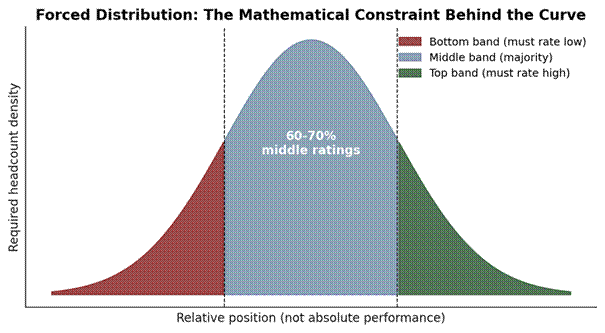
Figure 1. The mathematical constraint behind any forced distribution: the curve requires a bottom band whether or not any contributor underperformed.
The remedy is not the abolition of accountability. Underperformance exists, must be addressed directly, and must be addressed defensibly. The remedy is the replacement of relative-comparison architectures with absolute-standards architectures, supported by capability ladders, role-maturity criteria, continuous management cadence, and calibration audits that measure fairness and outcome rather than distribution compliance. High-performing organizations have moved in this direction over the past fifteen years. The patterns are mature enough to be implemented as a governance program rather than as an experiment.
This paper offers a governance framework, the FCG Performance Governance Framework, structured as five layers: foundations, performance models, decision rights, telemetry and audit, and outcomes and capital. The framework is intended to function as a reference architecture in the same sense that a power and cooling reference architecture functions in a data center: an explicit, inspectable, capital-bearing structure with named ownership at each layer. It is paired with a five-level maturity model, a transition roadmap, an indicative capital allocation, and an outcome measurement framework that links performance governance to talent durability, delivery durability, capital efficiency, and governance integrity.
The recommendations in this paper are deliberately direct. Forced curves are not a neutral instrument that produces good or bad outcomes depending on execution. They are a control system whose design pre-commits an organization to a specific set of behaviors. Organizations that retain a forced curve in 2026 should expect those behaviors to continue and should price the resulting operational tax into their capital and lifecycle planning. Organizations willing to undertake a structured transition can expect measurable improvement in attrition, knowledge reuse, lifecycle delivery, and audit defensibility within twenty-four months, with capital efficiency gains continuing to accumulate beyond that horizon.
The audience for this analysis includes boards and audit committees responsible for governance integrity; chief executives and chief operating officers responsible for delivery; chief human-resources officers responsible for the architecture of performance management; business-unit general managers responsible for outcomes; engineering and operations leaders accountable for lifecycle ownership; investors and lenders evaluating durability; and regulators evaluating fairness. The conclusions are technical, structural, and capital-bearing. They are not a referendum on individual managers, who in most organizations are operating their performance system as instructed.
The uncomfortable truth that ties this paper together is that forced percentile ranking does not merely measure culture. It actively manufactures it. When a system guarantees that someone must fail, failure becomes a built-in feature. Over time, the organization internalizes that logic, rewards behaviors that protect individuals at the expense of teams, and rewards teams at the expense of the enterprise. The result is a competitive-looking environment that quietly erodes the very foundations it depends on. The remainder of this paper makes that case structurally, comparatively, and with the specificity required to act on it.
Full white paper below
