
The Vanishing Worker
Age, Algorithms, and the Hidden Hiring Crisis Affecting Americans Over 40

Abstract
This white paper examines a structural and accelerating crisis in the United States labor market: the systemic exclusion of experienced workers over forty, with disproportionate impact on women, minorities, and long-tenured professionals, from access to the formal hiring pipeline. The crisis is not principally a function of underqualification, attitude, or unwillingness to adapt. It is the product of a hiring infrastructure that has been rebuilt over the past decade around algorithmic intermediaries, applicant tracking systems, vendor-supplied recommender models, and large-language-model resume scorers, layered onto a post-pandemic labor market that has experienced a white-collar recession, a generative-AI driven hiring slowdown at the entry and mid-career levels, a halving of the hires-per-posting ratio, and an estimated one-in-four ghost-listing rate in public job boards.
The legal landscape has begun to respond. The U.S. District Court for the Northern District of California has conditionally certified Mobley v. Workday as a nationwide collective action under the Age Discrimination in Employment Act, encompassing potentially millions of applicants over forty who applied through the Workday platform since September 2020. The Equal Employment Opportunity Commission previously settled with iTutorGroup over software that explicitly auto-rejected female applicants 55 and older and male applicants 60 and older. New York City’s Local Law 144, the Colorado AI Act, and a growing patchwork of state AI-hiring statutes now place affirmative obligations on employers deploying automated employment decision tools.
This paper synthesizes labor statistics from the U.S. Bureau of Labor Statistics, EEOC charge data, AARP survey research, academic field experiments, and public reporting on the AI hiring supply chain. It documents the technical mechanisms by which facially neutral inputs such as graduation year, total years of experience, vintage of vocabulary, and email-domain choice function as proxies for age. It traces the cost calculus that drives employer behavior. It examines the apparent paradox of industries such as cybersecurity in which a structural skills shortage coexists with experienced professionals unable to secure interviews. And it proposes practical, executable frameworks for three audiences: the experienced job seeker, the hiring organization, and the board or executive team that owns the governance footprint of AI-enabled employment decisions. The conclusion is that the crisis is solvable, but only if it is treated as the structural infrastructure and governance problem it actually is, rather than as a series of individual misfortunes.
Executive Summary
Capable, experienced, often elite professionals in the United States are unable to find work. The pattern is now too consistent and too broad-based to be dismissed as anecdote. AARP’s 2025 survey research indicates that 37 percent of workers 50 and over experienced age discrimination during job search in 2025, up from 30 percent in 2024. Glassdoor reported a 133 percent year-over-year increase in worker mentions of ageism in the first quarter of 2025. The Bureau of Labor Statistics reports that long-term unemployment, defined as 27 weeks or more without work, now affects 27.5 percent of jobseekers 55 and older, materially higher than younger cohorts. Researchers conducting controlled resume-audit studies have found that applicants ages 40 to 49 receive 38 percent fewer interview callbacks than younger applicants with identical qualifications, and applicants 50 and over receive 62 percent fewer.
The mechanism is not solely human bias. Roughly three-quarters of Fortune 500 employers use applicant tracking systems with built-in scoring or filtering capability. A growing share use vendor-supplied AI recommender models that rank candidates against historical hiring data. When that historical data is itself biased toward younger hires, the model learns and accelerates the bias. The Mobley v. Workday litigation, certified in May 2025 as a nationwide ADEA collective action, represents the first serious legal test of the doctrine that a third-party software vendor can be directly liable for discriminatory outcomes under federal employment law. The iTutorGroup settlement, in which automated recruiting software auto-rejected applicants based on birth date, established that intentional algorithmic age discrimination is actionable and settleable.
Layered onto the algorithmic problem are macro-level disruptions. The white-collar job posting index has fallen 36 percent since the first quarter of 2023. Layoffs explicitly attributed to artificial intelligence by employer disclosures rose more than twelve-fold between 2023 and 2025. Stanford Digital Economy Lab research finds a 16 percent decline in early-career employment in AI-exposed occupations since the late-2022 release of ChatGPT. The hires-per-posting ratio has halved since 2019, and an estimated one in four public job postings is a ghost listing with no near-term intent to hire. The result is a labor market in which the visible signal of available roles materially overstates the actual hiring activity, and in which the signal that does exist is preferentially filtered to favor younger, lower-cost, more easily-trainable candidates.
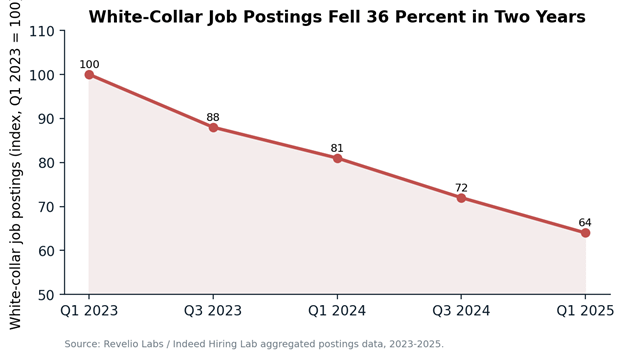
Figure 1: White-collar job postings have fallen sharply since early 2023, compressing the absorption capacity of the labor market for experienced professionals.
The intersectional dimensions of the problem deserve specific attention. Women over 50 face what social scientists have begun to call the menopause penalty, a documented pattern of being passed over for promotion or pushed out of roles in their late forties and fifties. Black women over 40 report the highest rates of perceived hiring discrimination of any demographic intersection in AARP research. Highly credentialed workers in cybersecurity, where the industry simultaneously claims a multi-million-role talent shortage, are nevertheless unable to secure interviews because the shortage is concentrated at the mid-career and senior levels while applicant tracking systems and HR organizations are calibrated for entry-level intake.
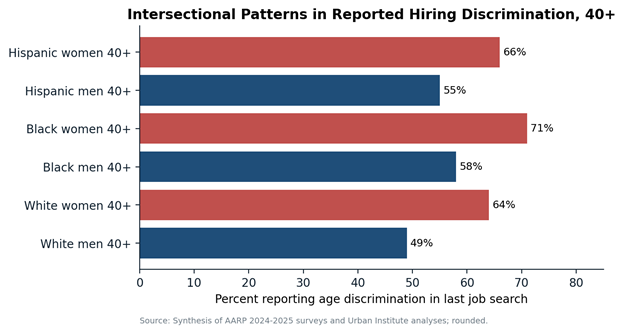
Figure 2: Reported hiring discrimination concentrates more heavily on women and minority cohorts within the 40-and-over population.
The second-order economic costs are substantial. Ageism in the workplace was estimated by AARP to cost the U.S. economy approximately $850 billion in lost gross domestic product as of 2018, and the expansion of automated screening since then has almost certainly widened that gap. Vacant senior roles cost organizations meaningful capital in lost productivity, project delay, knowledge transfer overhead, and recruiter fees, none of which appear on the recruiting cost line item.
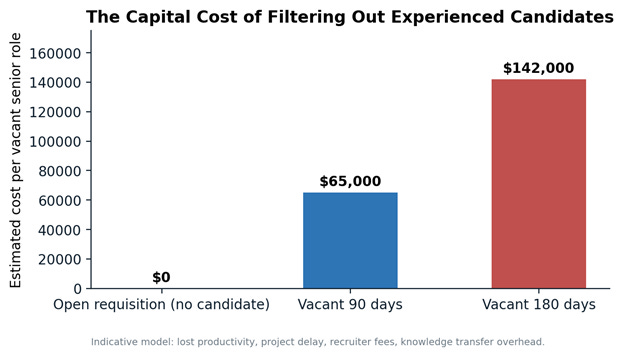
Figure 3: Indicative capital cost of holding senior requisitions open while filtering out experienced candidates.
This paper proposes three coordinated remediation frameworks. For the experienced job seeker, a structured weekly operating cadence that shifts effort from low-yield aggregator boards to high-yield direct outreach and network activation, combined with a disciplined resume and digital-presence remediation strategy. For the hiring organization, a reference hiring pipeline with bias-control touchpoints, a vendor-governance posture toward AI recruiting software, and an explicit human-review escalation path. For boards and executive leadership, a governance reference architecture covering vendor due diligence, bias telemetry, candidate notice, litigation readiness, and capability-maturity benchmarking. The paper concludes that the structural collapse of the over-40 labor market is a solvable problem, but only if it is treated as a first-class infrastructure and governance issue rather than as the individualized misfortune of those it affects.
Whole white paper below
