
Data Center KPIs — A Comprehensive Look
Build, Operations, and IT Metrics, the Tools that Capture Them, and What They Mean

Executive Abstract
Key performance indicators are the connective tissue of a modern data center program. They link sensor readings on a chiller to board-level discussions about return on invested capital. They convert kilowatt-hour costs into per-token costs. They translate millisecond voltage transients into corrective work orders. Without KPIs, a data center is a warehouse of expensive machinery; with KPIs, it is a financial engine that can be tuned, governed, and scaled.
This paper presents a comprehensive treatment of data center KPIs across three families: build-side metrics that govern capital deployment, operations-side metrics that govern day-to-day risk and unit economics, and information-technology-side metrics that govern the productivity of the silicon. It catalogs the dominant tool platforms — energy power management systems, building management systems, data center infrastructure management systems, IT service management systems, computerized maintenance management systems, and the lakehouse-and-business-intelligence layer — and explains how each contributes to the metric stack.
The paper introduces a six-tier KPI hierarchy that runs from the raw sensor tag at tier one to the board metric at tier six, and a five-level maturity model that classifies organizational discipline from ad-hoc spreadsheet reporting at level one to closed-loop optimization at level five. The framework is intended to give the reader both a comprehensive reference and a practical roadmap for upgrading their KPI program one level at a time.
The paper is organized into thirty-six chapters. Chapters one through five define the spatial frame and walk through the build, operations, and IT KPI families. Chapters six through ten develop the dominant efficiency, water, carbon, cost-per-token, and electrical-protection metrics in depth. Chapters eleven through fifteen catalog the tool stack from sensor to executive scorecard. Chapters sixteen through twenty develop governance, the maturity model, the operating cadence, the executive scorecard, and a reference implementation roadmap. Chapters twenty-one through thirty-six expand the program into capacity, commissioning, cybersecurity, sustainability, networking, vendor risk, workforce, customer SLAs, M&A diligence, anti-patterns, site selection, portfolio aggregation, telemetry retention, infrastructure-as-code, the next-generation architecture, and field-implementation notes. Four appendices contain a glossary, a tool catalog, a comprehensive KPI catalog, and a clickable reference list.
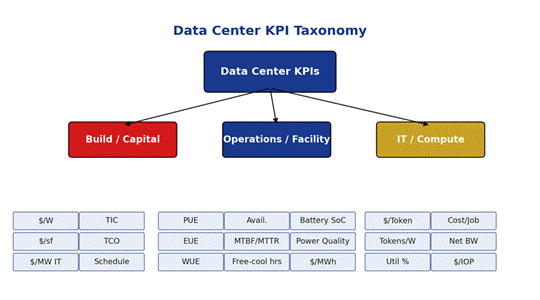
Figure A. KPI taxonomy at a glance.
BOTTOM LINE
A KPI is a contract that names an accountable owner, defines an evidence base, sets a trigger for action, and rolls into the next tier of the organization. Programs without explicit ownership and explicit roll-up paths produce charts, not KPIs.
Full white paper below
